Redefining Digital Fabrication: VUILD × Nikken Sekkei DDL
- #Knowledge
- #Architecture
- #Nikken Sekkei
- #Digital Fabrication
- #VUILD
When people hear the term "digital fabrication," many may think of "complex one-off forms" or "special expressions." But for this technology to truly spread in architecture and making, we need to face the question of how to make it more versatile and usable in many situations.
The joint project between VUILD and Nikken Sekkei DDL (Digital Design Lab) is an attempt to redefine digital fabrication not as a mere “special means of expression,” but as a highly versatile “new way of making” architecture.
Our goal was not to pursue a one-of-a-kind sculptural beauty, but to build an implementation model that can be widely applied while keeping the number of machining steps low. From this perspective came the concept of “Gi-Kakuzai” (pseudo-square timber).
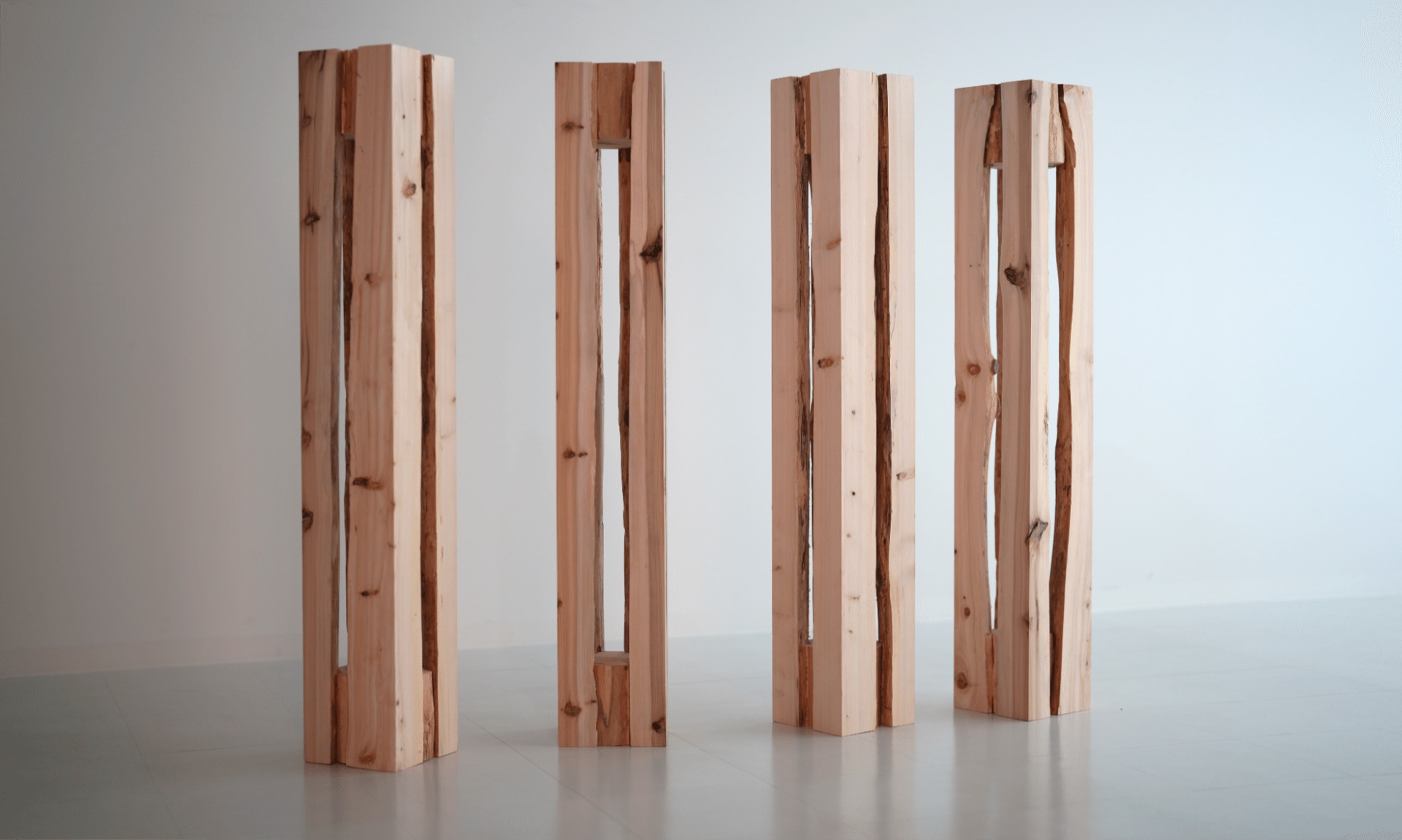
Through fieldwork in forests and sawmills, this project took on the challenge of standardizing, like dimensional lumber, timber that has conventionally been traded cheaply as fuel chips (C- and D-grade wood). To give it versatility while making the most of each material’s character, we developed our own scanning system and cutting jig. The six-month process of trial and error is packed with hints for updating architecture and design for the future.
In this article, those involved look back on the project, which ran from design through machining and testing as one continuous process.
[Profiles]
Kotaro Senpuku (Nikken Sekkei Ltd.)
Satoshi Takeuchi (Nikken Sekkei Ltd.)
Tomonori Yamakawa (Director, VUILD Inc.)
Yuki Mizuno (Architectural Engineer / Designer, VUILD Inc.)
[About Nikken Sekkei DDL]
DDL (Digital Design Lab) of Nikken Sekkei’s Tech Design Group is a specialist team whose mission is “from imagination to experience, from experience to value,” creating new value in social environments, including cities and architecture, through information and technology. It works across practical projects and research and development.
Digital fabrication ≠ one-of-a-kind? Pursuing versatility
Yamakawa This project didn’t start with a specific goal. It was a pretty loose start, more like “We’d like to team up and do something together.” What did you expect from VUILD at first?
Senpuku Within DDL at Nikken Sekkei, we had more and more opportunities to use digital fabrication, but we felt it was still limited to somewhat special situations. We were exploring how to scale digital fabrication and turn it into an everyday architectural method.
That’s when you reached out, Yamakawa-san, and as we talked we felt our directions matched, so this collaboration got started.
Yamakawa That’s right. We kicked off loosely, introducing ourselves and sharing our research.
Senpuku Yes. I feel we gradually sharpened the picture by presenting digital fabrication study ideas to each other.
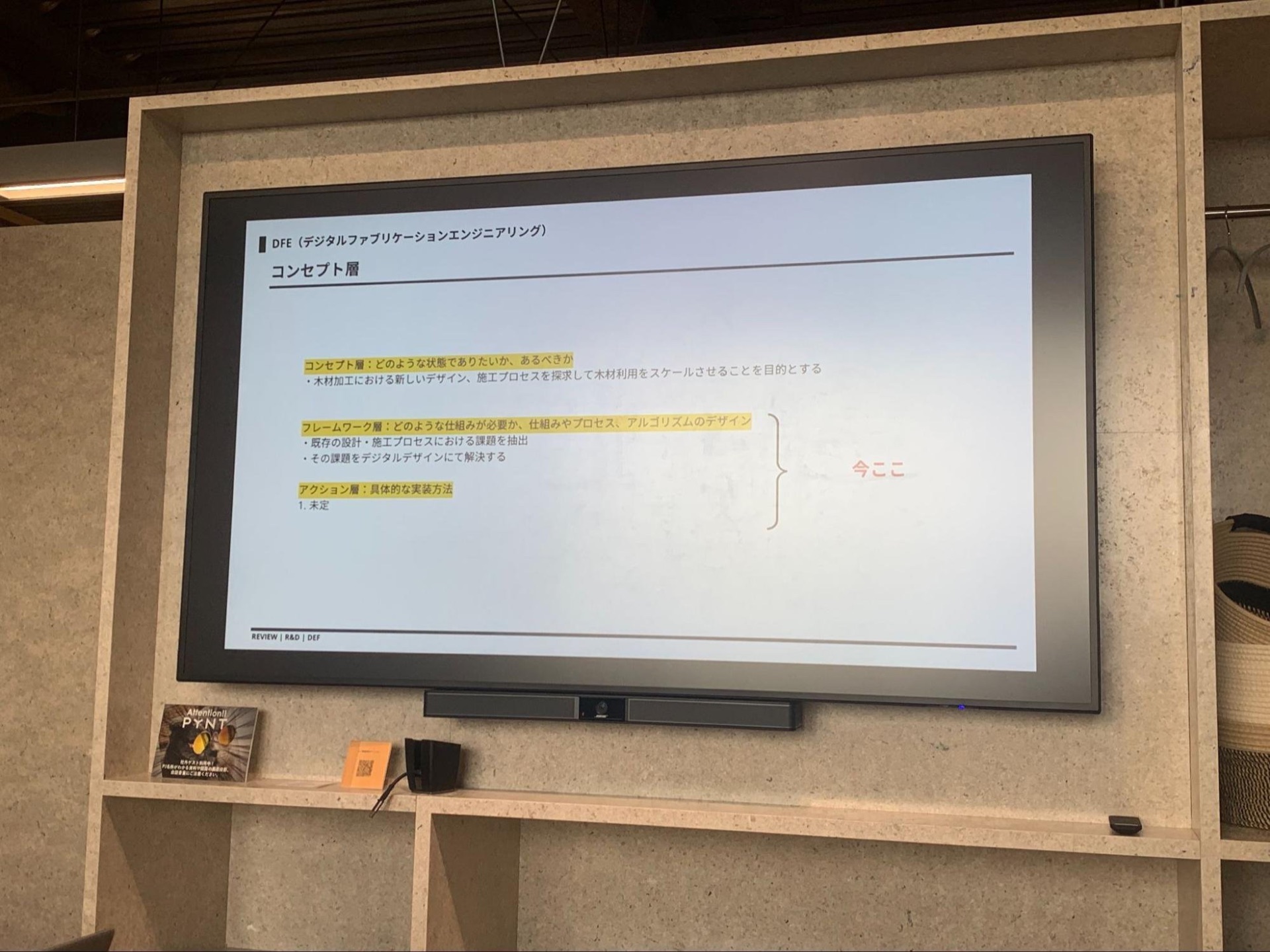
Mizuno At that point, we noticed that the ideas we both liked shared a common keyword: “a way of making with fewer steps.” The perspective was how far we could minimize the steps in design, machining and assembly.
Yamakawa We gradually came to share the understanding that the challenge for VUILD and DDL was not to chase “one and only” originality to the extreme, but to make things more versatile by reducing the number of steps.
The reality of forestry revealed through fieldwork
Yamakawa Going to forests and sawmills early on was also a big deal, wasn’t it? What did you feel during that fieldwork?
Takeuchi Visiting two forests and sawmills made a big difference. I could feel first-hand that the problems each forest and sawmill faces are completely different.
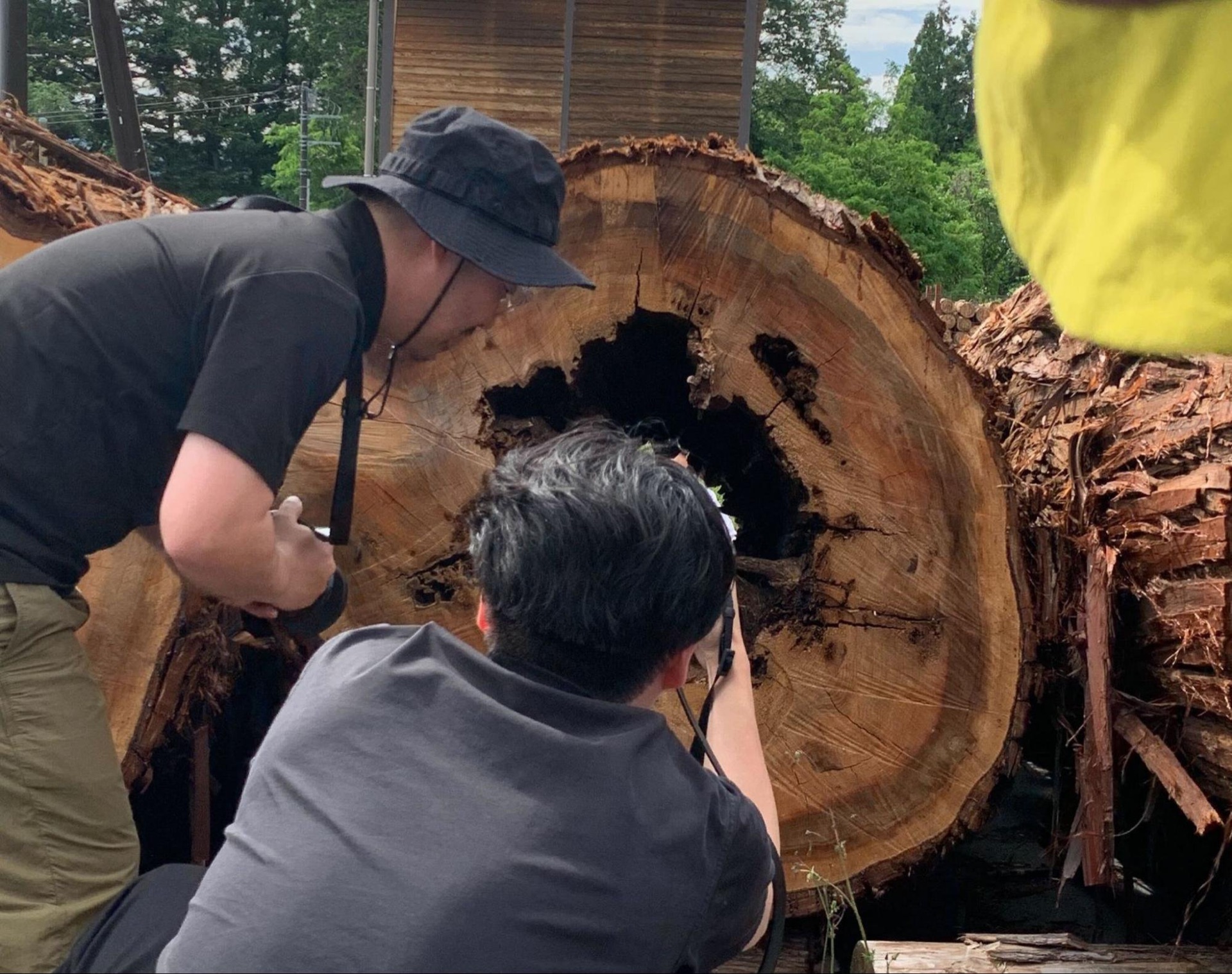
Senpuku It was a good opportunity to expand our ideas, and above all, it was great to have the experience of cutting a tree with my own hands. When I talk to people, I often find that the problems of forestry are surprisingly poorly understood, and I think that’s because there is a distance between forests and people.
By going into the forest myself this time, I came to feel the issues of forestry much more closely. Even when presenting this project, I feel that the fact that we did fieldwork makes it more convincing.
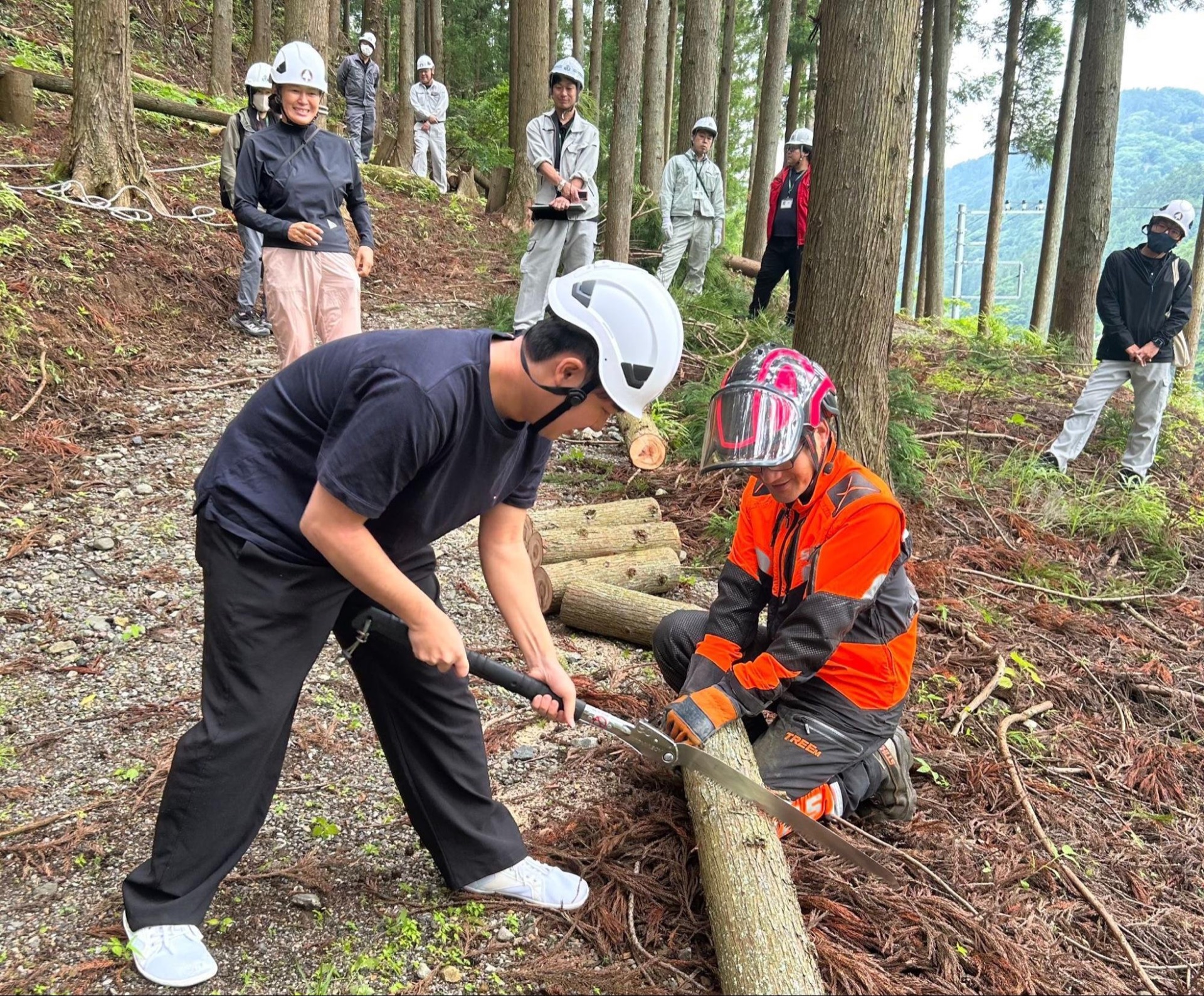
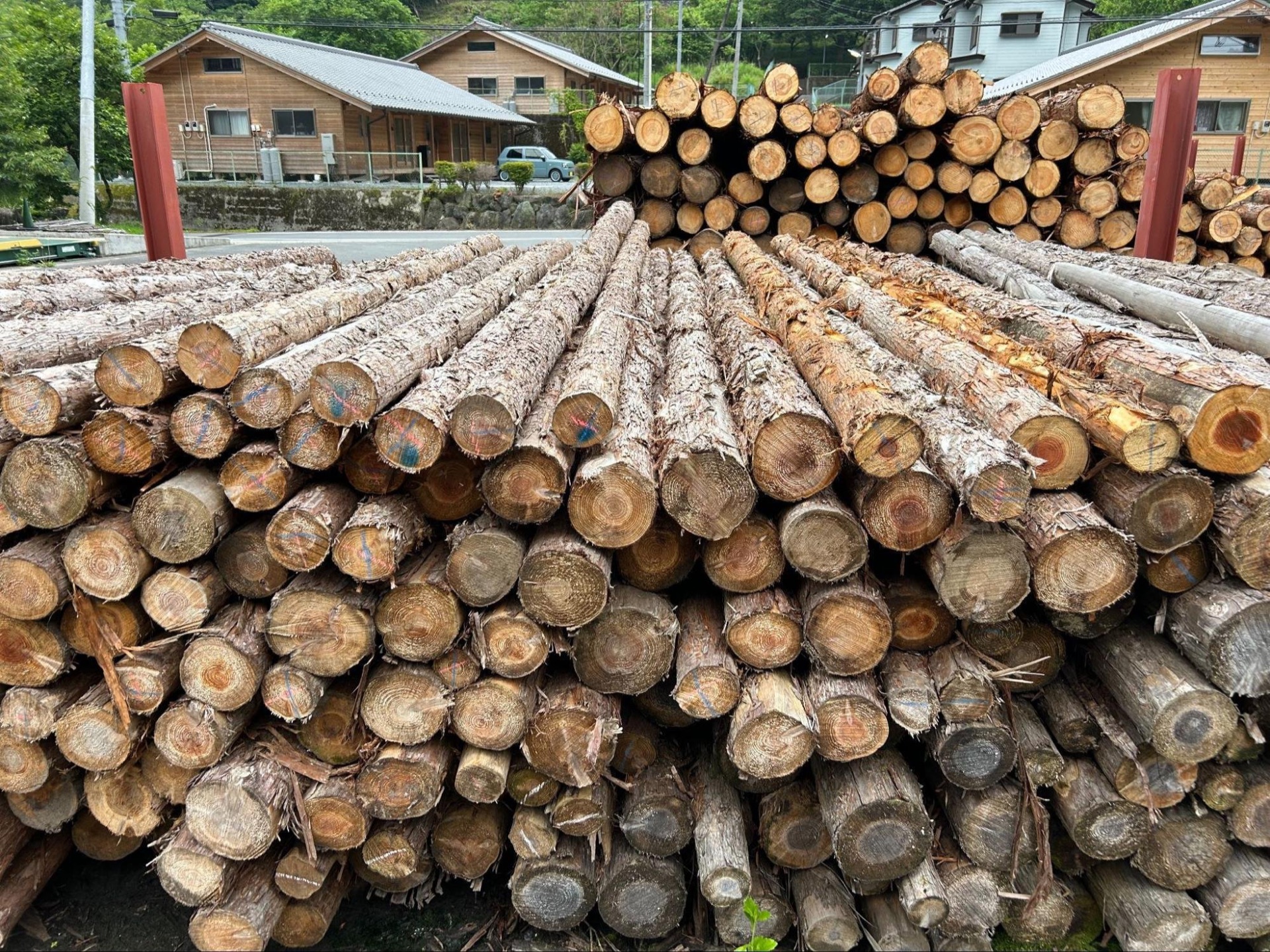
Yamakawa We visited two sites: one in Kawaba Village, Gunma, where high-performance forestry machines are used, and one in Kanna Town, where trees are felled with chainsaws. Going there gave us the perspective of finding some way to use “irregular timber,” such as C- and D-grade wood that usually ends up as chips.
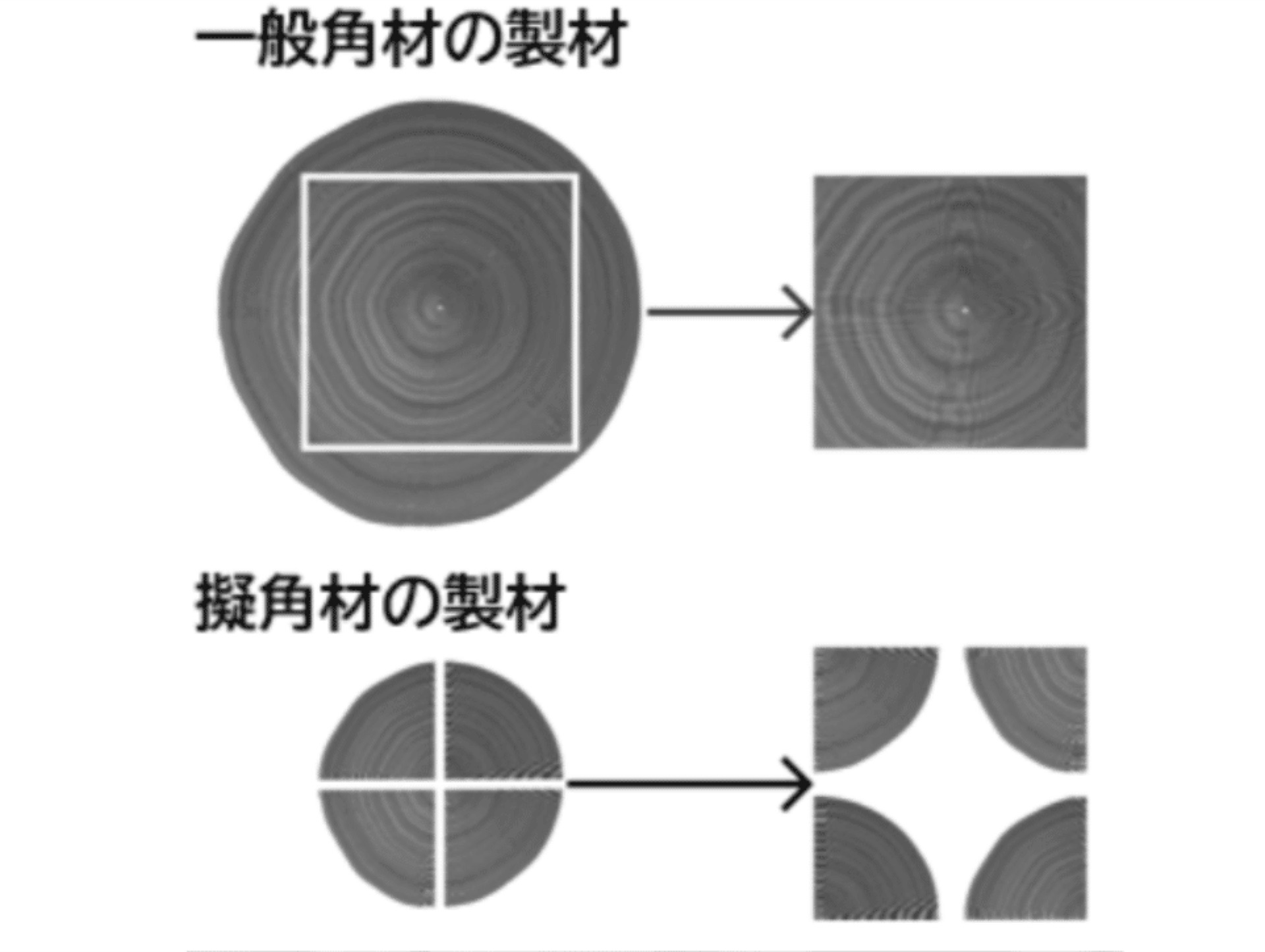
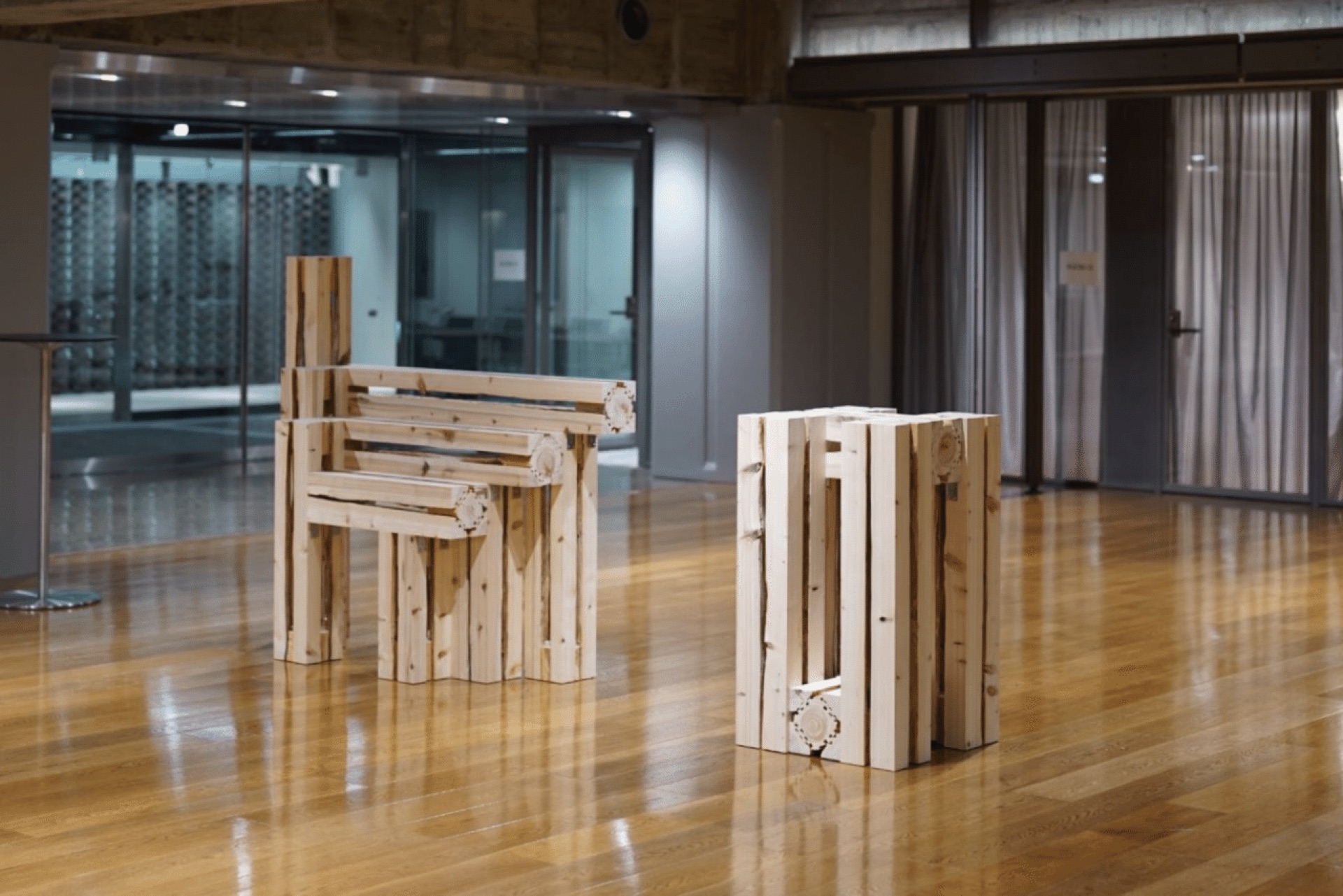
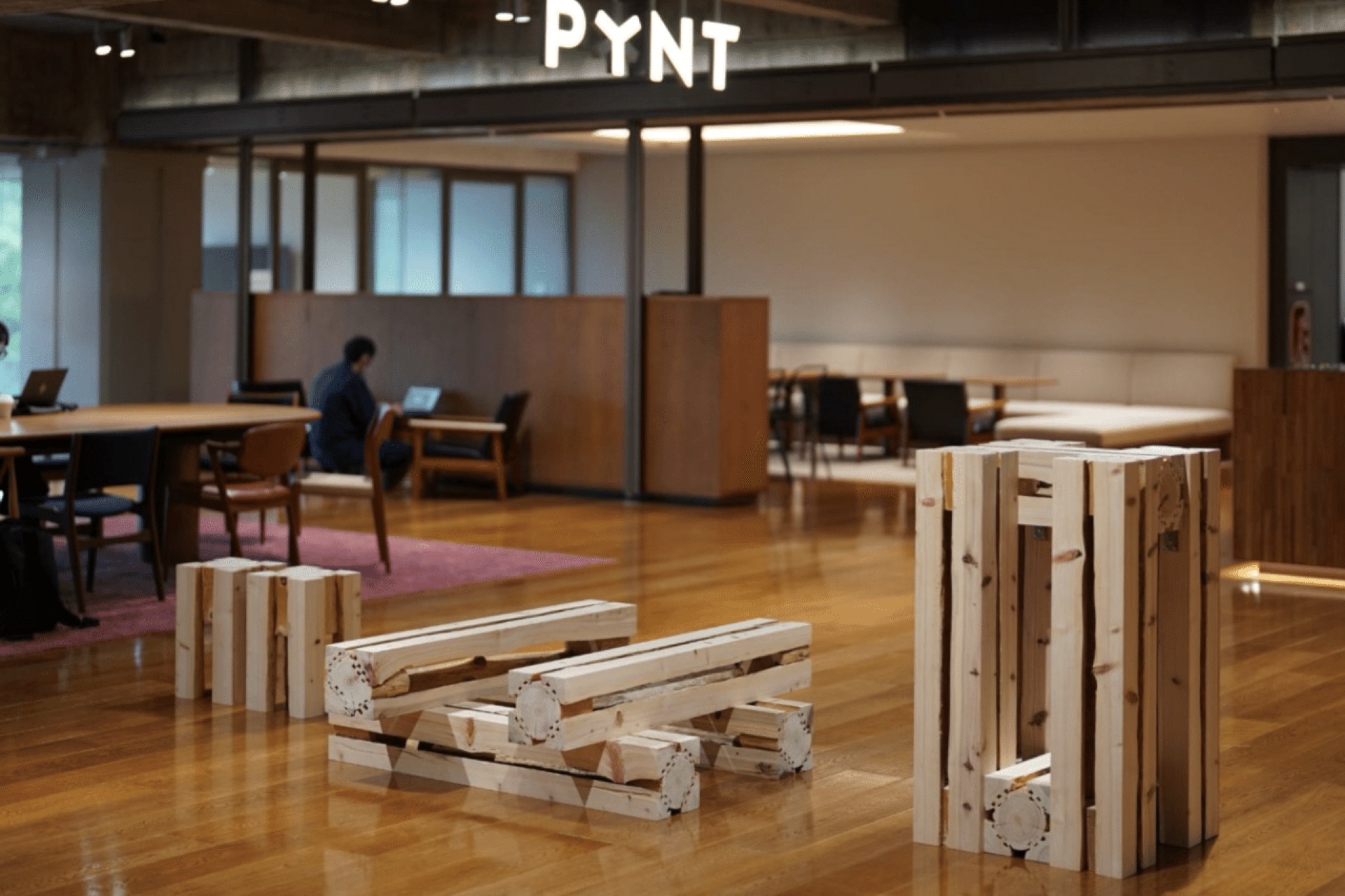
Senpuku The idea of “Gi-Kakuzai” was born from studies using that irregular timber. When you saw a log into square timber, the result is smaller than the log’s diameter, but “Gi-Kakuzai” standardizes the material while keeping material loss to a minimum.
A digital solution that turns irregular timber into a "standard"
Yamakawa After the fieldwork set the direction for “Gi-Kakuzai,” what was the hardest part of the actual fabrication process?
Mizuno This is from personal experience… (laughs) scanning is really hard. Still, when using irregular timber, scanning is an unavoidable step. So this time, we concluded that we would scan only the necessary areas locally.
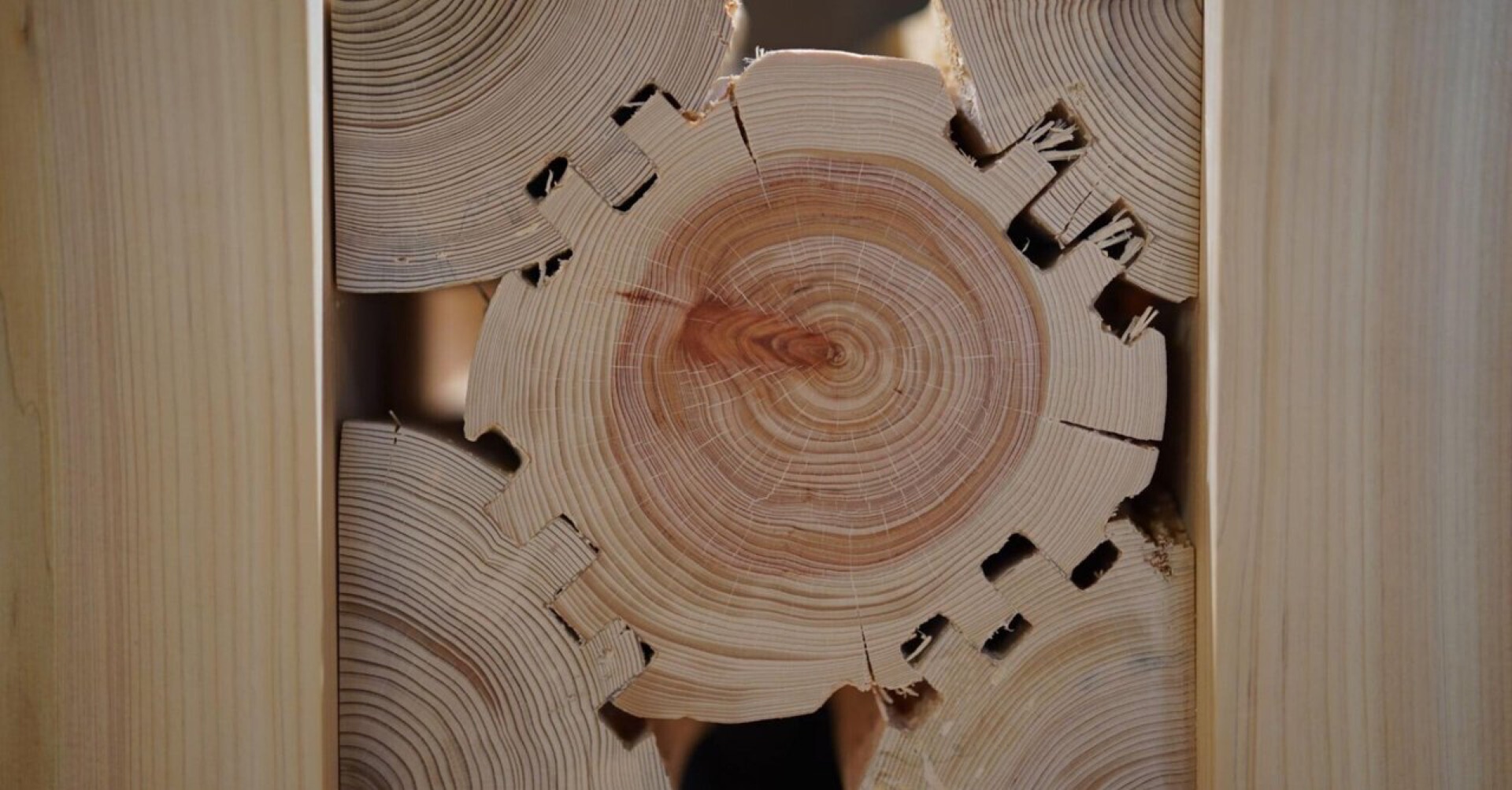
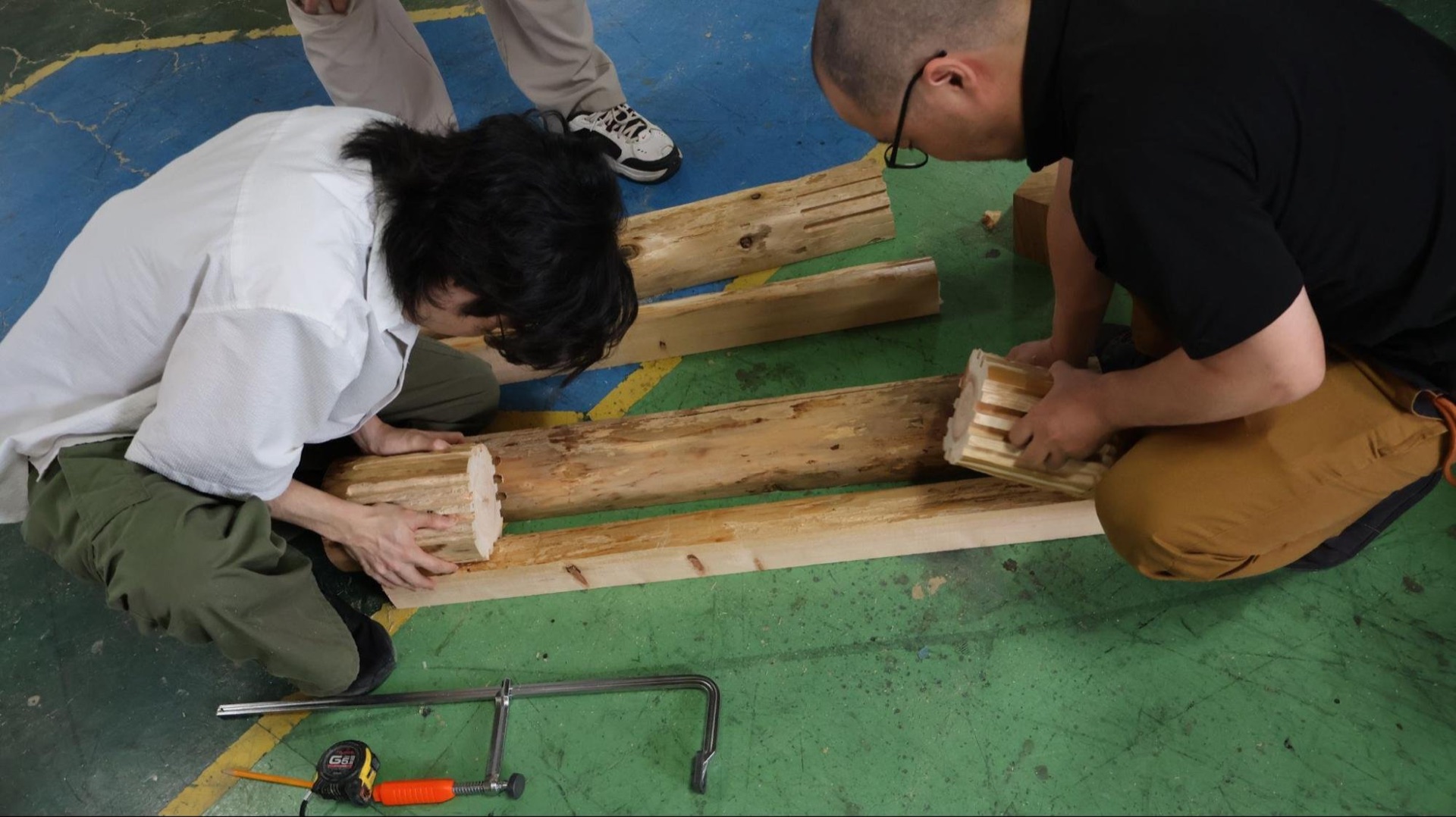
Senpuku Create flat surfaces through partial scanning and machining, and keep the steps down. That way of thinking eventually led to the idea of “inside out.” If you split a log lengthwise into four and reassemble the pieces with the core facing outward, the outer shape becomes a rectangular box like square timber, while the rough bark-side surface of the log remains on the inside. It can be handled with the same dimensional system as ordinary square timber, yet it has the expression of a log. That is “Gi-Kakuzai.”
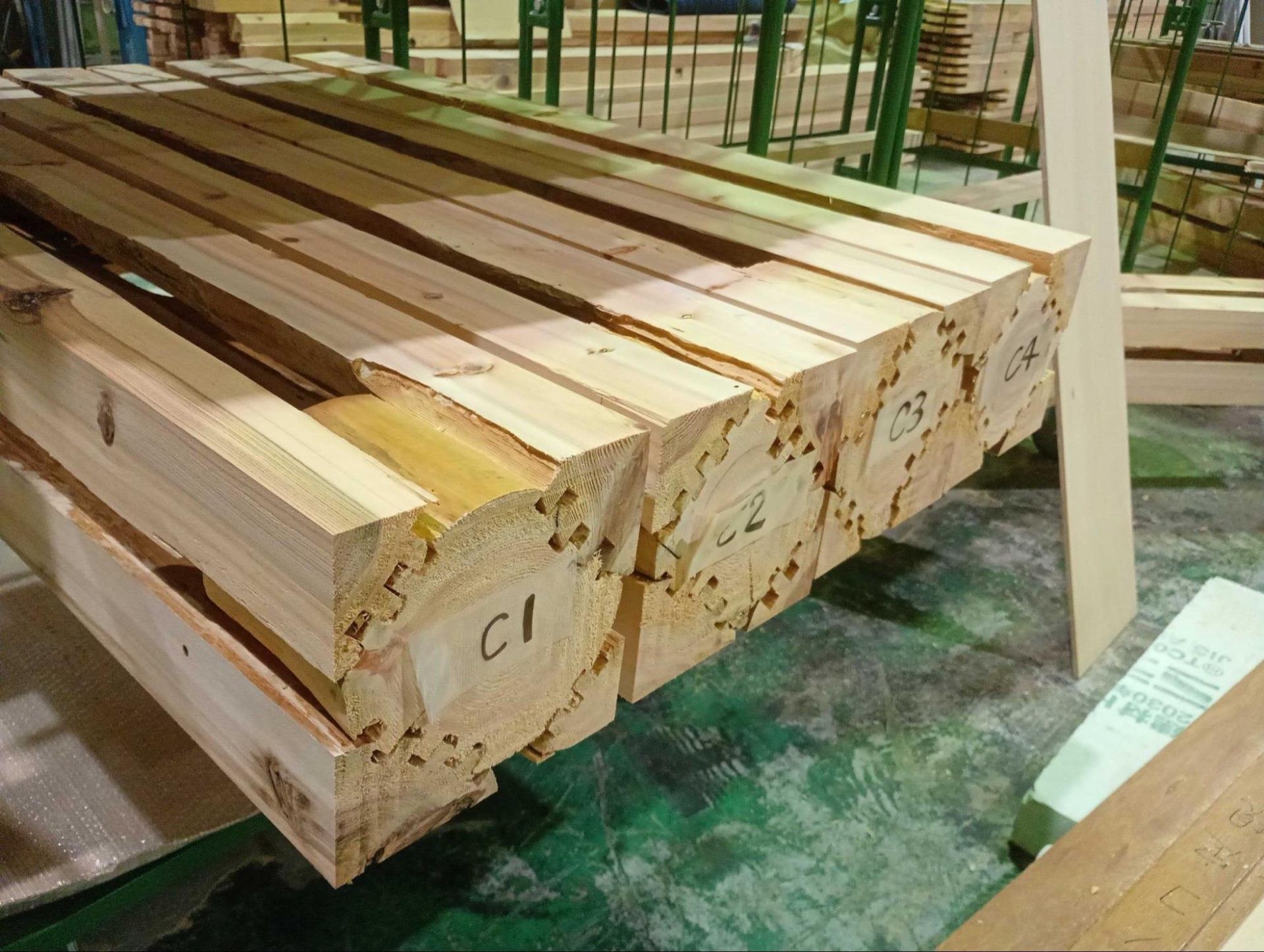
Mizuno The biggest hurdle was how to handle irregular timber on the ShopBot. Normally you align dimensional lumber to the origin, but this time we developed a dedicated jig that lets us machine the material while rotating it 90 degrees at a time. As a result, a single ShopBot could machine about 80 quartered pieces and about 40 logs in one week, greatly reducing the number of steps.
We built a jig that rotates the timber by driving toggle clamps with sharpened tips into the center of both ends of the log. By defining distances from the center of the joint, we made it possible to create toolpaths and align the material from an unchanging “central axis,” even for irregular timber.
We worked backward from the toolpaths to identify only the joints where the logs and quartered pieces intersect, and scanned those spots precisely. Normally you hold a scanner and walk around the material many times to scan the whole thing, but this time we fixed the scanner above the ShopBot’s spindle. We adopted a method of moving the axis to each machining position and scanning repeatedly in sequence, as if taking photos.
Takeuchi There are still many small issues, but it was great that we could bring it to a certain level in such a short time. I think it became a project that can keep scaling. Now that it has taken shape, ideas are coming in from within the company, such as “I want to build a sauna with this.”
Yamakawa That’s great to hear. How was it working with VUILD this time?
Senpuku Actually, when this project started, some members worried that we might end up competing in digital design. But once we actually did it, I felt we divided the work well.
VUILD gave feedback to the design side through the machining process, while DDL gathered various kinds of information and designed it as one continuous process. I think we moved forward together while each staying aware of our roles.
Mizuno Even within digital design, we’ve been through different projects, so each company has its own knowledge. DDL’s approach to managing data and their resolution on details were very instructive. We each use digital tools differently, which made me realize you can’t generalize about “digital,” and I think this project was possible precisely because there were two companies.
Takeuchi It was also great that, thanks to a shared vocabulary of digital design, we could instantly understand what each other meant. I think this team is why we could move at this speed.
Yamakawa Because it was digital × digital, we could rapidly cycle through defining questions together, coming up with ideas and testing them.
Reinventing the "way of making" itself
Yamakawa This time we were able to give shape to one architectural standard as “Gi-Kakuzai.” Do you have any thoughts on what comes next? At VUILD, a key idea is “reinventing the way of making”: not necessarily creating something from zero, but making use of templates and modules.
Senpuku Yes. Rather than generating everything from zero, we often think about how things should behave under given conditions within a set of established modules, so I relate to the idea of “reinventing the way of making,” and I’d love to do something together again.
Yamakawa We’d like to work on things where even the grammar of making is different.
Senpuku It would be great to design using what we produced this time, and to create a system that spreads beyond our own hands. And if we could even make it local production for local consumption, I feel we’d be closer to truly solving the problem.
I think the appeal of digital design is being able to “create systems for designing,” exactly what VUILD is working on now, and this project may be one part of that.
I also think processes like this one exist precisely because we are in an era where digital fabrication plays a bigger role. As DDL thinks about design methods for a new era, we want to dig deeper into the approach of this project.
Takeuchi When Yamakawa-san first told us, “You have to go to the mountains!”, I didn’t think that fieldwork would turn out to be so important. But looking back, I feel everything came from there.
Yamakawa I love seeing designers come alive when they learn about the background of forestry. I’m looking forward to more interesting projects like this one. Thank you for today.
It’s okay if you haven’t decided what to create yet.
Across design, fabrication, and construction,
we design the very path to realization itself.
Please feel free to get in touch.
It’s okay if you haven’t decided what to create yet. Across design, fabrication, and construction, we design the very path to realization itself. Please feel free to get in touch.
何をつくるか、まだ決まっていなくても構いません。設計、製造、施工を横断し、「実現の道筋」 そのものを設計します。ぜひ、お気軽にお問い合わせください。